
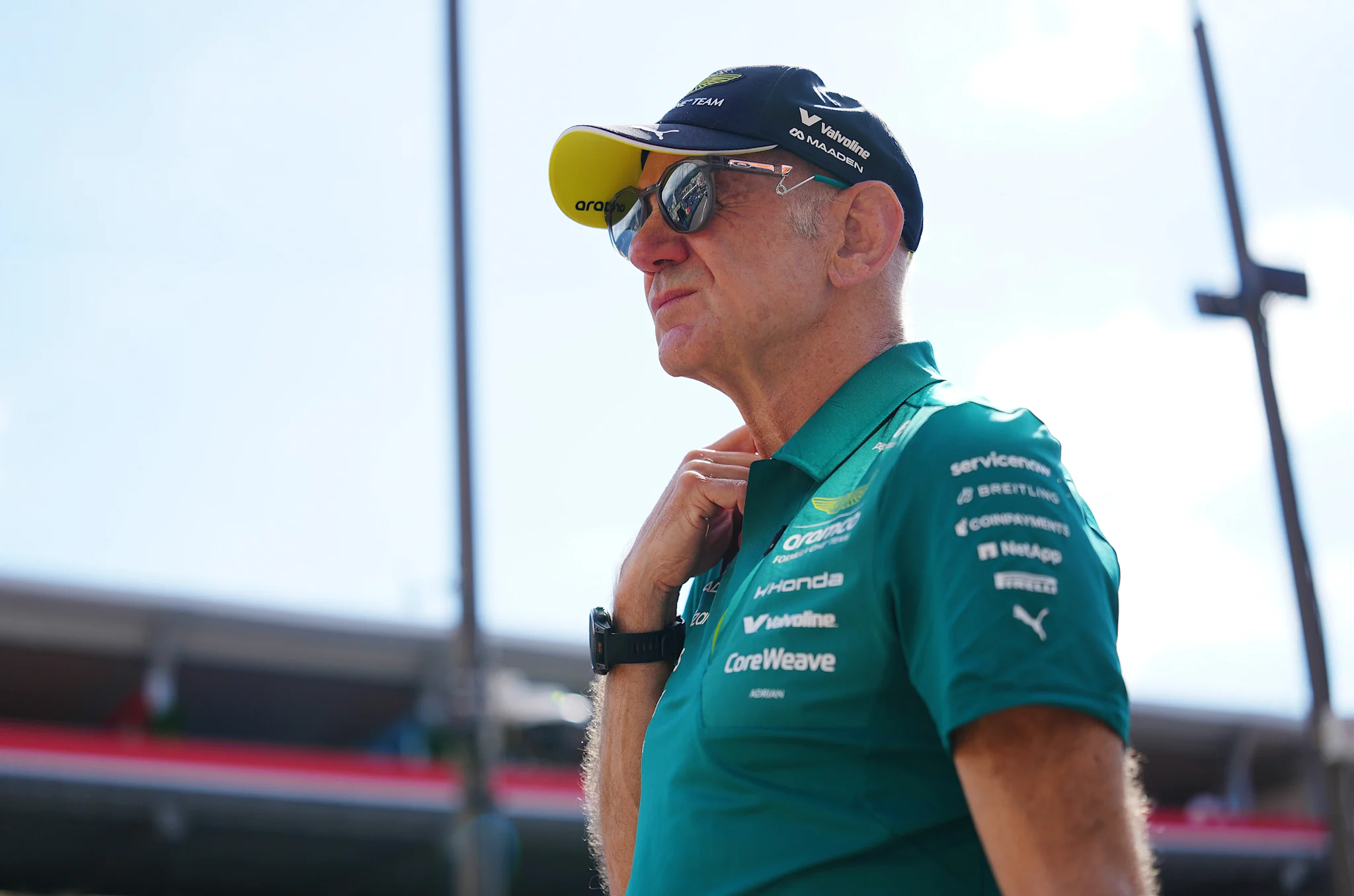
Aston Martin Team Principal Adrian Newey has laid bare the full extent of the team’s troubled 2026 campaign, revealing that outdated infrastructure dating back to the Jordan era, severe power unit problems with Honda, and a rushed design process have left the squad languishing at the back of the grid — but confirmed a substantial upgrade package will arrive at the Hungarian Grand Prix later this month.
In an interview published on the team’s official website, Newey disclosed that Aston Martin did not achieve a proper power unit run until Free Practice 3 at the season-opening Australian Grand Prix, having spent most of pre-season testing in the garage wrestling with integration issues between the Honda power unit, chassis, and gearbox.
“Melbourne was the wake-up call,” Newey said. “Before that, in Barcelona and at the two Bahrain tests, we spent too much time in the garage just trying to get the power unit to run correctly with the chassis and gearbox. You know the idiom, ‘it never rains, but it pours’, and this is one of those classic cases where it felt like everything that could go wrong, did go wrong.”
The problems extend far beyond the power unit. Newey revealed that some of the team’s internal systems and processes trace their origins to the Jordan team, which first competed in Formula 1 in 1991 and occupied the same Silverstone base. “We were relying on tools and processes that had been patched and bodged for years,” he said. “At some point, a system that’s just patch-on-patch stops being fit for purpose. That’s where we had got to. The result was a very frustrating car build. Parts weren’t being ordered at the right time — not because people weren’t doing their jobs, but because the underlying system was failing them.”
Newey also acknowledged that serious development work on the 2026 car did not begin until mid-March 2025, well behind rival teams, with no wind tunnel models tested until a month after that. The compressed timeline forced him to pursue a bold aerodynamic direction without exploring multiple concepts, and the car arrived significantly overweight. “When you design in a rush, weight is the first thing that suffers because you don’t have the time to thoroughly optimise everything,” he admitted.
The team made what Newey called a “painful decision” to forgo incremental upgrades at recent races, choosing instead to pool resources into a single major package for Hungary, scheduled for July 24-26. The upgrade includes a re-homologated and crash-tested forward chassis, a new nose, substantially revised aerodynamic surfaces, a slightly revised rear suspension, and significant weight reduction across the chassis and gearbox. Aston Martin have also shifted production of key components — including the floor and gearbox casing — in-house for greater control.
“The target is to get very close to the weight limit,” Newey said. “We’re predicting a large step, but I’m reluctant to put specific numbers out there because our simulation tools aren’t yet as sophisticated or well correlated as they need to be.”
The stakes extend beyond lap times. Two-time World Champion Fernando Alonso has publicly stated he is weighing his options for next season, with retirement from racing among the possibilities. Alonso, who scored eight podiums with the team in 2023, has managed just a single point at Monaco this season while suffering four retirements, including at his home race in Barcelona. He has said any decision on his future will hinge on the performance gains delivered by the upcoming upgrades.
Newey conceded the team has been “effectively standing still in relative terms” while rivals have brought consistent development to every round, making each weekend feel increasingly difficult. But he framed the approach as a deliberate long-term strategy, insisting that pushing through the current difficulties will position Aston Martin for more substantial progress in upcoming seasons.