
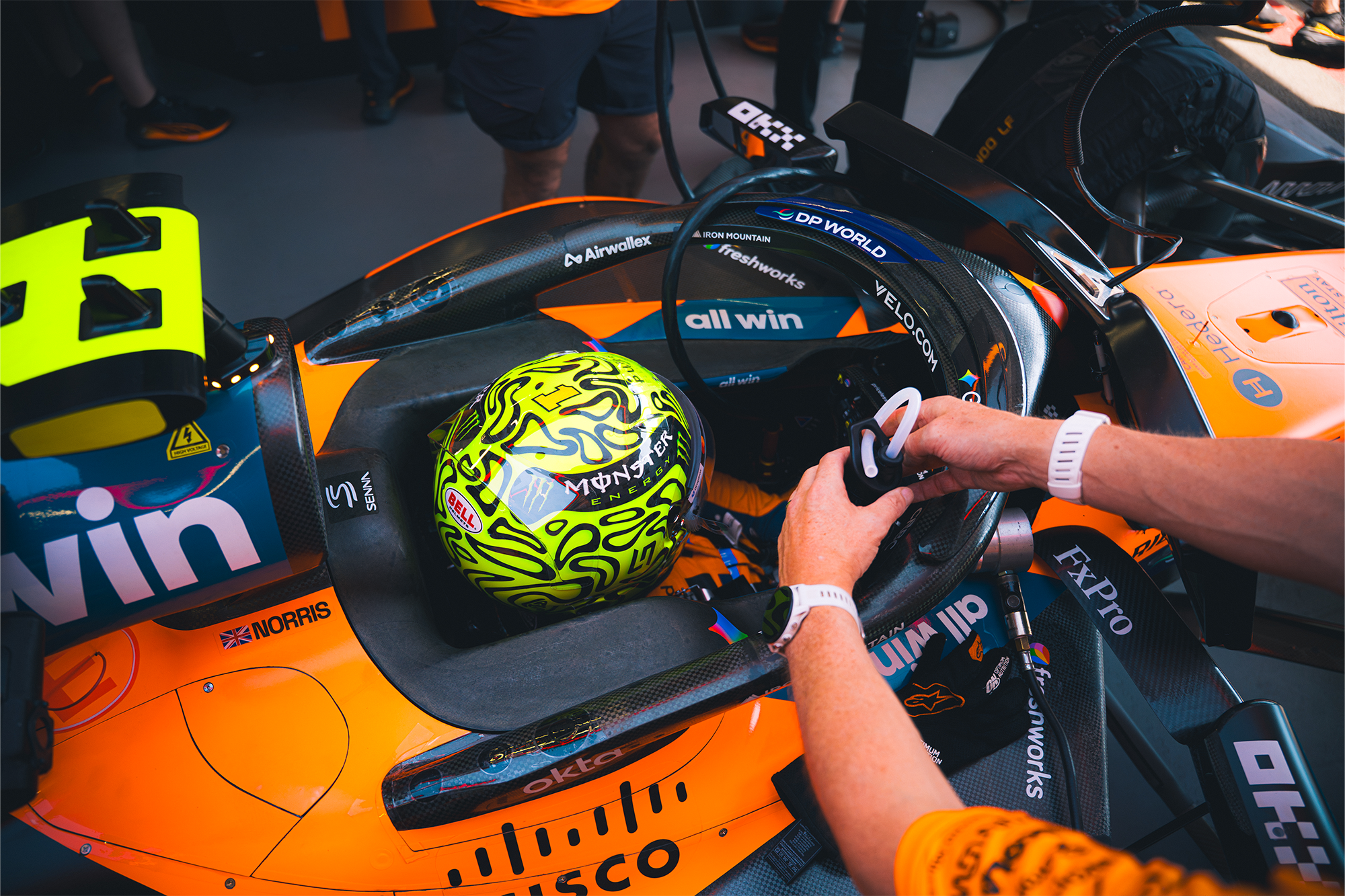
McLaren arrived at the 2026 Azerbaijan Grand Prix with one of the most comprehensive upgrade packages of its season, debuting new bodywork, sidepods, floor, suspension fairings, and an eighth rear wing specification for the MCL40 at the Baku City Circuit — only to encounter floor damage on both cars during an otherwise productive opening day of practice.
Chief Technical Officer and Chief Designer Rob Marshall confirmed the scale of the package ahead of Free Practice 1, describing changes that extended from the front of the sidepods all the way to the rear of the car. New radiator inlets bonded to the chassis, a new engine cover, and a revised floor were among the headline items, with suspension fairings redesigned to work in concert with the updated aerodynamic surfaces.
“New bodywork, new sidepods from front to back, including the stuff that’s bonded to the chassis like the radiator inlets, and a new engine cover all the way to the rear,” Marshall said. “We’ve got a new floor and new suspension fairings that are sympathetic to both that new floor and the bodywork. We’re also bringing another rear wing.”
The new rear wing — the eighth specification developed for the MCL40 this season — is a rotating H-wing configured to a higher downforce level than the version McLaren ran at Monza. The team now has three rear wing options available for the remainder of the weekend: the high downforce conventional wing used at the Madrid street circuit, the medium downforce rotating H-wing from Monza, and the new higher downforce H-wing introduced in Baku.
Marshall acknowledged that the team’s understanding of the 2026 regulations had evolved significantly since the start of the season, including on the question of rear wing development. “This time last year, we were genuinely talking about perhaps needing only one spec of rear wing for 2026,” he said. “That’s not been the case. We’re continuing to find performance in rear wings, and that’s simply a good example of our understanding of the regulations, and the impact they have on these cars, developing over time.”
Despite the ambition of the package, the opening day of running was not without difficulty. During Free Practice 1, Lando Norris’s car sustained damage to the front of the floor on both sides, with no immediately obvious cause identified. The team monitored Oscar Piastri’s car as a precaution and observed a similar issue developing. An interim fix was applied between sessions, with a more comprehensive solution planned ahead of Friday’s running.
Piastri also dealt with vibrations in his front brakes during FP1. The team elected not to change them mid-session, prioritising track time at a circuit where accumulated laps are considered directly valuable to driver confidence and lap time. The brakes were replaced ahead of Free Practice 2.
In a structured comparison exercise during FP1, Piastri ran the new H-wing specification while Norris ran a previous rear wing for back-to-back data. With the new wing performing as intended, both cars were fitted with the updated specification for Free Practice 2.
Marshall described the Baku City Circuit as a track of extremes that presents a distinctive challenge under the 2026 regulations. The circuit combines Formula 1’s longest straight with some of its tightest corners, creating a lap he characterised as two distinct halves — a high-speed opening sector where tyres and brakes cool, followed by a technical second sector where thermal loads build sharply.
“Very quick, with the car getting cold for the first half, and slower for the second with everything getting hot: tyres, brakes, engine,” Marshall said. “That’s going to be a challenge to setup.”
On energy management, Marshall suggested Baku’s high number of braking zones should provide meaningful recovery opportunities, potentially enabling a range of deployment strategies that converge on similar lap times. He also indicated the circuit could produce more overtaking than in previous years under the new regulations, though he cautioned that practice data would be needed to confirm that assessment.
Looking beyond this weekend, Marshall was direct about the rationale for continuing development at this stage of the season. Regulation changes are coming for 2027, but he said the team expects most of the conceptual learning from this year’s car to carry forward. “There are regulation changes for next year, and they are not insignificant — but they don’t affect our confidence that a lot of the learning we do on this year’s car will be carried straight over,” he said. “Most of what we’re doing we think will be cut-and-paste carry over. At least, in concept.”
The team will work overnight to improve the MCL40’s balance ahead of final practice and qualifying.