
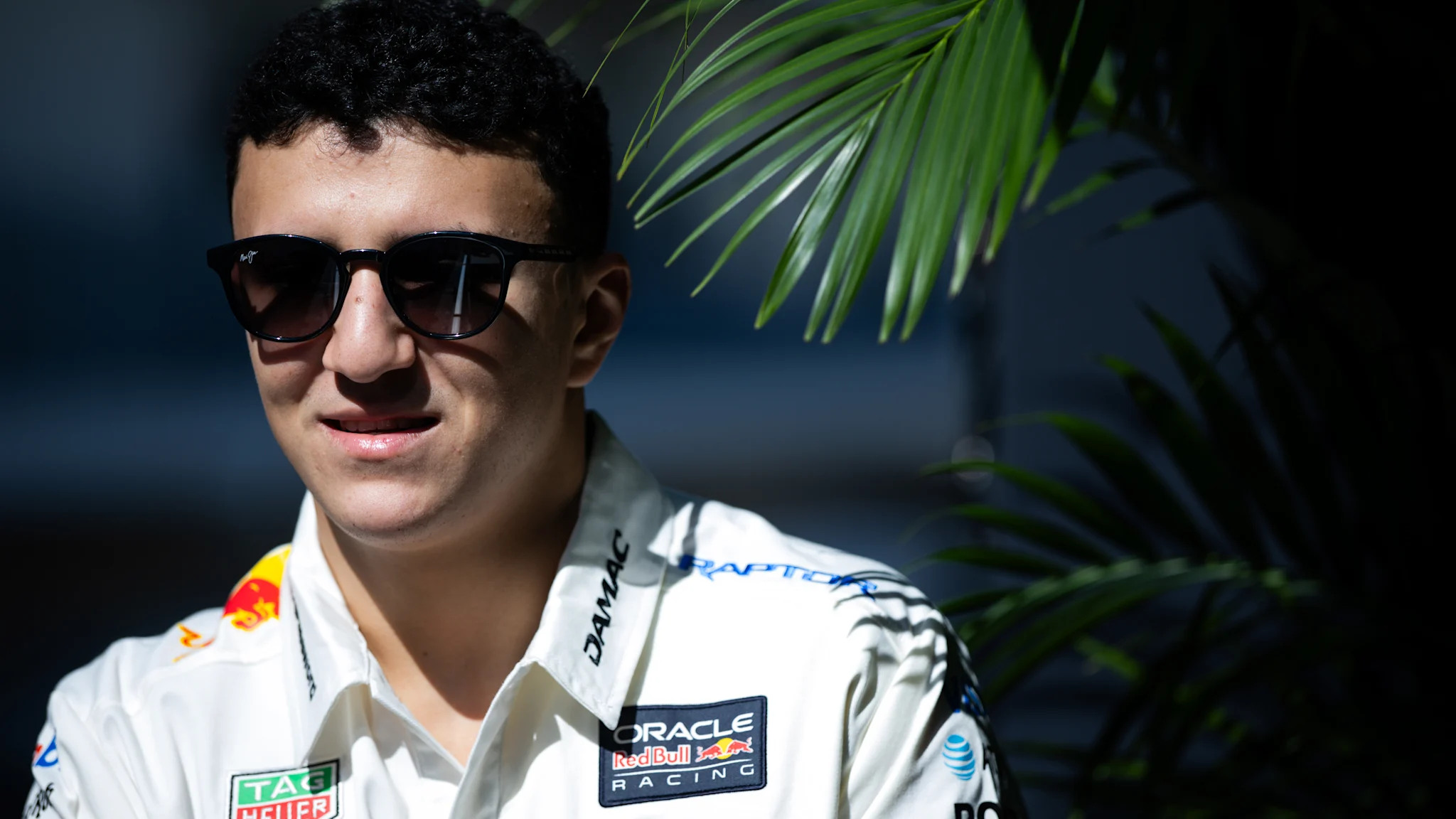
Isack Hadjar described his Red Bull RB22 as “undriveable” after finishing ninth in second practice at the United States Grand Prix in Austin, 0.931 seconds adrift of teammate Max Verstappen, following set-up changes that caused severe front tyre overheating.
The French rookie called the session “a disaster,” explaining that his car performed adequately on the medium compound but fell apart on the soft tyre after the team altered the setup between FP1 and FP2. Front tyre temperatures spiked through the high-speed corners in Sector 1, leaving Hadjar with no grip for the remainder of each lap.
“After Sector 1, basically, where I made most of my lap time, from Sector 1 to the end of the lap, I was slower than on the medium,” Hadjar said. “It was just undriveable, and I was losing the front end massively. So we need to have a look, because that’s not normal, why there’s so much deg on one lap.”
Verstappen, who topped the Red Bull timesheets in third place behind Charles Leclerc and Kimi Antonelli, did not experience the same difficulties. He had a power steering issue addressed after FP1 but was otherwise untroubled by the setup direction that hampered his teammate.
Hadjar acknowledged the contrast between the two sides of the garage. “Yeah, if they managed to do it on the other side,” he said. “The temperatures are going sky high, and we’re going at the same speed. So we need to tweak something on the car balance, because we’re running different stuff.”
Red Bull Technical Director Pierre Wache confirmed the team had moved in the wrong direction with Hadjar’s car and said engineers were working to reverse the changes. He stressed the two cars’ setups were not drastically different but that COTA’s characteristics punished any miscalculation.
“I think if you overcook the tyre there, after it’s more or less finished for the lap,” Wache said. He also pointed to the circuit’s notorious bumps as a compounding factor. “The problem with this type of setup we are using, that is quite not as stiff as last year but not so far, is that the car is not very compliant on these bumps here.”
Wache identified low-speed performance as the team’s primary focus heading into qualifying. “It’s clearly the low speed performance where we are focused on at the moment — low speed is the key for us,” he said. Hadjar expressed cautious optimism that Saturday’s adjustments would restore the car to its FP1 level, saying the team needed to “bring it back at least to the level it was this morning.”