
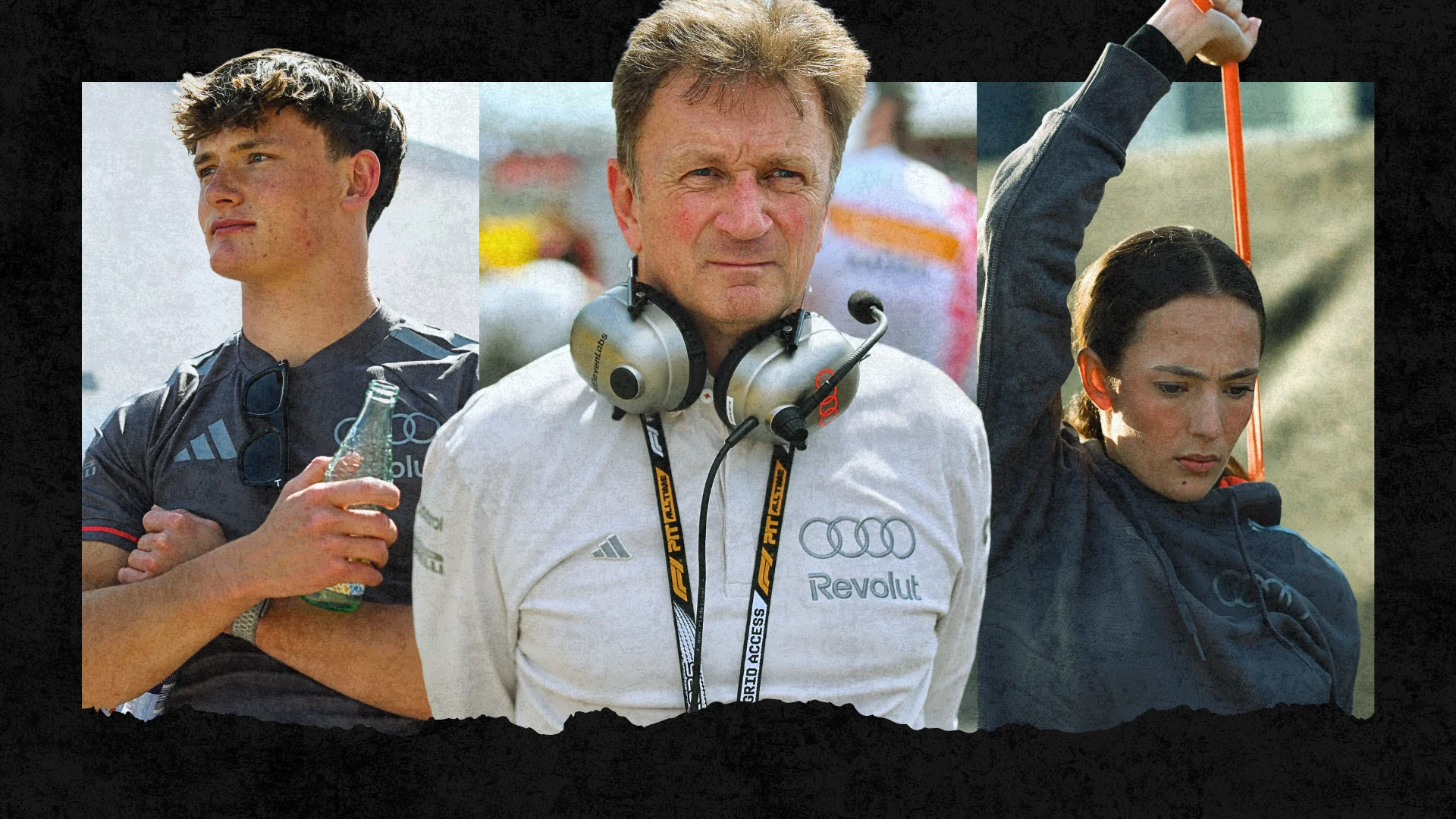
Audi’s Formula 1 operation has revealed the inner workings of its Driver Development Programme, launched in January ahead of the manufacturer’s maiden season as a works outfit, with Formula 3 racer Freddie Slater and F1 Academy competitor Emma Felbermayr signed as the programme’s first two prospects under the guidance of Racing Director Allan McNish.
The programme, which McNish began planning as far back as 2023, is designed not only to identify and cultivate future F1 talent but also to provide holistic support for young drivers navigating the demands of professional motorsport. Former F1 Academy racer Carrie Schreiner serves as a mentor within the structure, offering first-hand experience to the programme’s participants.
“When we were looking at Formula 1, and general planning concepts, it was quite clear that one key part — and a key part that I know very well — is the driver,” McNish told Formula1.com. “The driver is not just someone driving fast, they’re also a kind of leader within the team. It was quite clear that we need to be in a position, if we’re wanting to be serious and fight at the top level, to actually have the right drivers involved in our programme.”
McNish, who raced in F1 with Toyota in 2002 and has long been embedded in Audi’s motorsport operations, described the programme as “a living organism” that must evolve alongside its drivers. He revealed that Audi F1 driver Gabriel Bortoleto was on his original shortlist of six prospects alongside Slater, noting that Bortoleto “has evolved a lot in the last 24 months” since progressing to Formula 1.
The programme has already expanded its support infrastructure since launching. Giampaolo Dall’Ara, who served as the team’s Head of Race Engineering last season, has transitioned into a driver development role. Personnel from marketing, communications, and human performance departments also contribute to the drivers’ growth on and off the track.
Slater highlighted the breadth of support available. “They provide a lot of experiences behind the scenes — media training and things like this — and we evaluate after every race weekend how it went with Audi people and with Allan as well,” he said. “Allan is very experienced so we get to have good conversations with him about how the weekend went, what can we improve on. My goal is to become better every single day and they give me the opportunity to do that.”
Felbermayr, the 19-year-old Austrian now in her second F1 Academy season, pointed to the physical development support as particularly valuable. “We get support from medics, getting the whole body scanned at the beginning of the year to know where you are, and then just building on that during the season to get stronger every day,” she said. She also credited Schreiner’s mentorship as instrumental during her transition into F1 Academy, saying the two have developed a close friendship through regular calls and race weekend support.
McNish emphasized that the programme carries a moral obligation beyond simply producing F1 drivers. With only 22 seats on the grid, he acknowledged the programme must prepare young drivers for their futures regardless of whether they ultimately reach the pinnacle of the sport. He stressed the importance of allowing prospects to make mistakes in a supportive environment, comparing the development journey to “a long, long university.”
“You can never put an old head on young shoulders, but you can definitely support them to try and make the right mistakes because they will make mistakes,” McNish said. “Everybody makes mistakes. Nico Hulkenberg makes mistakes, Gabi makes mistakes. It’s about how you deal with them.”